
Why Data is Critical for Selling Biologicals in Agriculture
The bio-based agricultural market is experiencing rapid growth, with significant R&D expenditures and company acquisitions throughout the industry. Biological products are entering the market at a rapid pace, driven by low barriers to entry and increasing demand for alternative products. But here’s the challenge: many of these products are launched without a clear understanding of where, how, or when they should be used. They struggle to differentiate themselves in the crowded market. As a result, farmers—who may be risk-averse when it comes to introducing new products—are overwhelmed with options, yet remain skeptical.
In this environment, data isn’t just important—it’s essential.
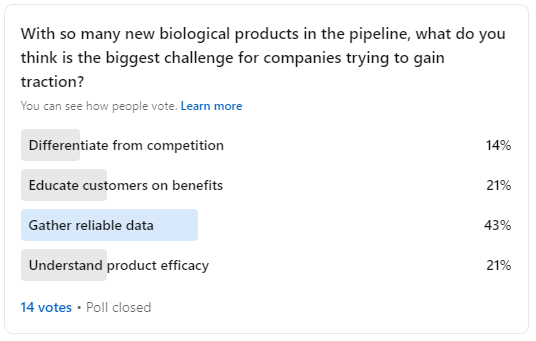
A poll we conducted on LinkedIn recently highlighted this challenge. 43% of respondents cited gathering reliable data as the biggest hurdle for companies trying to gain traction with new biological products. This reinforces the idea that while innovation is booming, the lack of focused, data-supported positioning is holding many products back.
Broad Messaging is a Missed Opportunity
Unlike traditional chemical inputs, biological products rely heavily on specific environmental conditions, soil types, and crop variations to be effective. This means that what works on one farm may not necessarily work on another. Unfortunately, many companies don’t understand the precise conditions under which their products perform best. They lack the data to inform their market strategy, instead opting for vague, one-size-fits-all positioning.
The problem is twofold:
- Lack of differentiation – Products are not clearly positioned against their competitors, leading to a crowded market where everything sounds the same.
- Vague problem-solving – Companies aren’t clear about the specific issues their products solve, leaving farmers confused as to the value the product represents to their farm.
Farmers need more than just broad claims about how biologicals are good for overall soil health or abiotic stress. They want to know exactly how the product will help their farm, under their specific conditions. Without this clarity, adoption rates stall, and companies miss the opportunity to build trust with their target audience.
As Shane Thomas pointed out is a recent Upstream Ag post, “That’s part of what has troubled biostimulant perception in the market. When you try to be everything to everyone, you become nothing to everybody.” You can read more about his thoughts on biological investments and positioning at the link.
How INVISION Can Help Biological Companies
Companies need to understand their own products by gathering and assessing field-level data and leaning into the areas that show the most promising results. This is where INVISION comes into play.
INVISION, the award-winning platform, helps biological companies gather the precise data they need to focus their product positioning. Instead of relying on scattered data from a handful of field trials, INVISION provides real-time data on product performance combined with environmental context, helping businesses create focused, data-backed messaging.
“No other platform gives companies the ability to collect and analyze the kind of focused data that INVISION does,” says Randy Barker, CEO of INTENT. “We built INVISION to help agribusinesses see the full picture, ensuring they have the right data to make informed decisions and position their products effectively.”


Project Management and Local Support:
INTENT’s Added Value
INTENT’s Added Value
Biologicals are incredibly sensitive to local conditions, and without field trial data that demonstrates their efficacy under specific circumstances, your product risks being overlooked by farmers. Beyond data collection, INTENT offers full project management support, acting as an extension of your team. We help you gather data, run trials, and ensure your biological products are backed by reliable, farm-specific information.
Kevin Heikes, co-founder of INTENT, says,
“Our team provides hands-on support to ensure you’re not just running trials—you’re collecting the right data to prove your product’s value in the field. When you have data farmers can trust, selling a biological product becomes less about convincing and more about showing the proof.”
Farmers Want Proof Not Promises
The truth is farmers aren’t interested in being the guinea pigs for new products. And vague, broad promises don’t inspire confidence. But when you provide farmers with focused, reliable data, they understand their value, and trust that your biological product will deliver results.
As the biologicals market continues to grow, the companies that succeed will be the ones that understand the critical role of data in product adoption. Don’t let unclear messaging hold your product back. If you’re ready to differentiate your biologicals with real and in-depth understanding, contact us today to learn how INVISION and INTENT can help.