

Opportunities and challenges of expansion in South America
Blog by: INTENT
Agriculture is growing at an exponential rate in Brazil and Argentina, where adoption of new technology is thriving. These countries are global leaders in several crops. Brazil has gone from a net importer of food to a major agricultural exporter, with Argentine exports not far behind. However, expanding into these growing South American markets can be challenging for start-ups and multi-national companies alike.
Brazil – A Big Market with Growth Potential
Driven by rising global demand and productivity, Brazil has become the second largest agriculture exporter in the world, with crops such as soybeans, corn, wheat, sugar, meat, coffee, and ethanol leading the charge. Ranking number one in soybean production, and third in the world for corn production, there is ample opportunity for growth in the country.
With mass application of crop nutrients and microbials that reduce soil acidity and fix nitrogen, as well as improved plant breeding, Brazil’s semi-arid farmland has been transformed from marginally unfarmable, to the world’s new breadbasket. According to the University of Illinois, Brazil is the fifth largest country in the world and has the largest area capable of expansion of any country that is already producing ag products. Out of 868 million acres, only 7.5% of this area is currently being used in crop production. Significant advancements are being made thanks to ag technology, government policies, and the introduction of crop biologicals are playing a pivotal role in bringing Brazil to the forefront.
Brazil has also been quick to adopt and grow GMO seeds, moving the productivity and yield ahead of conventional crops. In 2021, 95% of the 65 million hectares planted to soybeans, corn, and cotton were biotech varieties. Biotech varieties occupied 97% of the 38 million soybean hectares in Brazil. “Sustainability, technology, and digital farming are growing faster here than any other country… Biologicals, favorable politics, lower export taxes, and infrastructure investments in the countryside are making Brazil the pioneer of the South American innovation and future agriculture,” said Nicolas Reinoso, VP of South America at INTENT.

Planet imagery is integrated into the INvision platform on most test fields.
Argentina – An Agriculture Leader
Argentina’s vast farmland and favorable natural conditions have placed the country among the world’s leading agri-food producers and exporters. Large-scale farms, averaging about 1,500 hectares, occupy 78% of total agricultural land. Soybeans, corn, and wheat production are the top three produced and exported crops for Argentina. Due to the favorable farming conditions, Argentina is the perfect testing ground for companies specialized in farming innovations like biotechnology, crop protection, fertilizers, biologicals, seeds, and microbial ag inputs. These solutions allow businesses to expand using innovative new technologies to grow food more efficiently, profitably, and sustainably.
Another significant benefit of doing business in Argentina is its membership with Mercosur, a trading block made up of Argentina, Brazil, Paraguay, Uruguay, and other South American countries. If you are a member of Mercosur, the connections provided make expanding your business into the other member countries more achievable. “Argentina is well known for having proportionally more innovators than other countries in the region. The growers’ enthusiasm for testing new technologies is amazing and could give innovative companies a very fast concept test for a new technology in a short period of time,” states Nicolas.
Global Leaders in the Adoption of AgTech
Along with adopting biotech, Latin America is also the world’s most rapidly growing region when it comes to the funding of startup companies. According to Crunchbase, a leading business information company, venture capital investors poured a record $19.5 billion into startups based in Latin America last year. That was more than triple the amount invested in the region’s startups in 2020, turning Latin America into “the fastest growing region in the world for venture funding in 2021,” the firm said. Crunchbase is optimistic that the number of investments will be strong again for 2022 and beyond.
Access to broadband internet has aided the quick growth in agriculture innovation. As of 2018, 71% of Argentines were using the internet, with mobile subscriptions being common as well. Because of investment in digital infrastructure, Brazil and Argentina are becoming regional leaders in agriculture startups and innovation. Many digital agriculture startups are in operation and gaining traction throughout the region’s agricultural ecosystem. These startups cover a wide range of technology from farm management and data analytics to marketplace platforms, agri-finance and water management, just to name a few. Both countries demonstrate the importance of an enabling ecosystem for digital agricultural innovation to scale and support the growth of small-scale entrepreneurs. Nicolas comments, “The innovation in digital platforms and technologies in the area are blooming daily and giving us the chance to speed up the race to the future way of farming. We have access to the most advanced and innovative tools and products, giving us the ability to continuously grow. We are no longer waiting for new technology to reach our country; we are developing the most advanced ag innovations right here.”
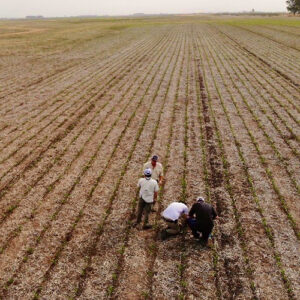
INTENT out in the field checking emergence of the crop in a South American field.
Expansion Challenging for International Companies
“Being able to see imagery in context with all the other trial data, planting files, treatment zones, and data we collect with the INFIELD app in one spot, is powerful for the grower and client to see,” states Regev. “Viewing the layers together provides a clear picture of how the crop is progressing in both treated and non-treated areas of the field.”
For clients, satellite imagery provides an early warning system for product efficacy and can show alarming differences in plant health early on. This provides an opportunity to discover what might be causing issues. Looking at trials in specific areas, was it soil, weather, precipitation, or some other environmental disruption that may be causing problems? Clients can make changes with the trial, without waiting for the final trial results after harvest.
For farmers, satellite imagery integrates with precision agriculture at scale for farms of any size. Imagery early in the growing season can drive decisions to make mid-season nutrient applications, or spot pest or disease infestation problems. Providing broad coverage, field-level detail, and rapid access, Planet imagery offers valuable input at each stage of crop management. It can also help define management zones and, help build variable rate prescriptions for seeding and fertilizer application, which drives planning for next year’s crop. With imagery integrated into INvision, it’s easy to see the entire landscape of how the crop is developing, while also considering the test areas of the field.
INTENT’s goal is to offer visibility and consistent high-quality data throughout the growing season in each trial to our clients and farmers. Our unique approach brings together all aspects of a farmer’s production process into a scalable system that allows us to process data and deliver useful insights with even more speed and agility, which is crucial in the ever-changing ag environment.